
Fayette Arrest Court Records
After an arrest in Fayette County, the first public trail often appears in the Fayette Sheriff Inmate Lookup. That roster is useful for the booking number, booking date, statute, abbreviated offense description, Court/Warrant identifier, and bond field. It is not the final court record. The court record develops when a charge is filed, accused, indicted, amended, dismissed, pled, tried, or otherwise disposed in the correct court.
Fayette County's court structure is compact but divided by case type. Superior Court handles felony criminal charges. State Court handles misdemeanors, traffic citations, and county ordinance violations. Magistrate Court handles criminal warrants and warrant applications. Juvenile Court handles cases involving people under 17, so public access is not the same as adult criminal access. For the custody side of the arrest, use jail inmate records. For booking-photo access, use jail mugshots. Court records after an arrest require clerk and court verification rather than only jail roster review.
The Fayette County courts overview explains this division of responsibility by court and agency. The county courts overview identifies felony, misdemeanor, warrant, juvenile, prosecutor, and clerk roles in one place.
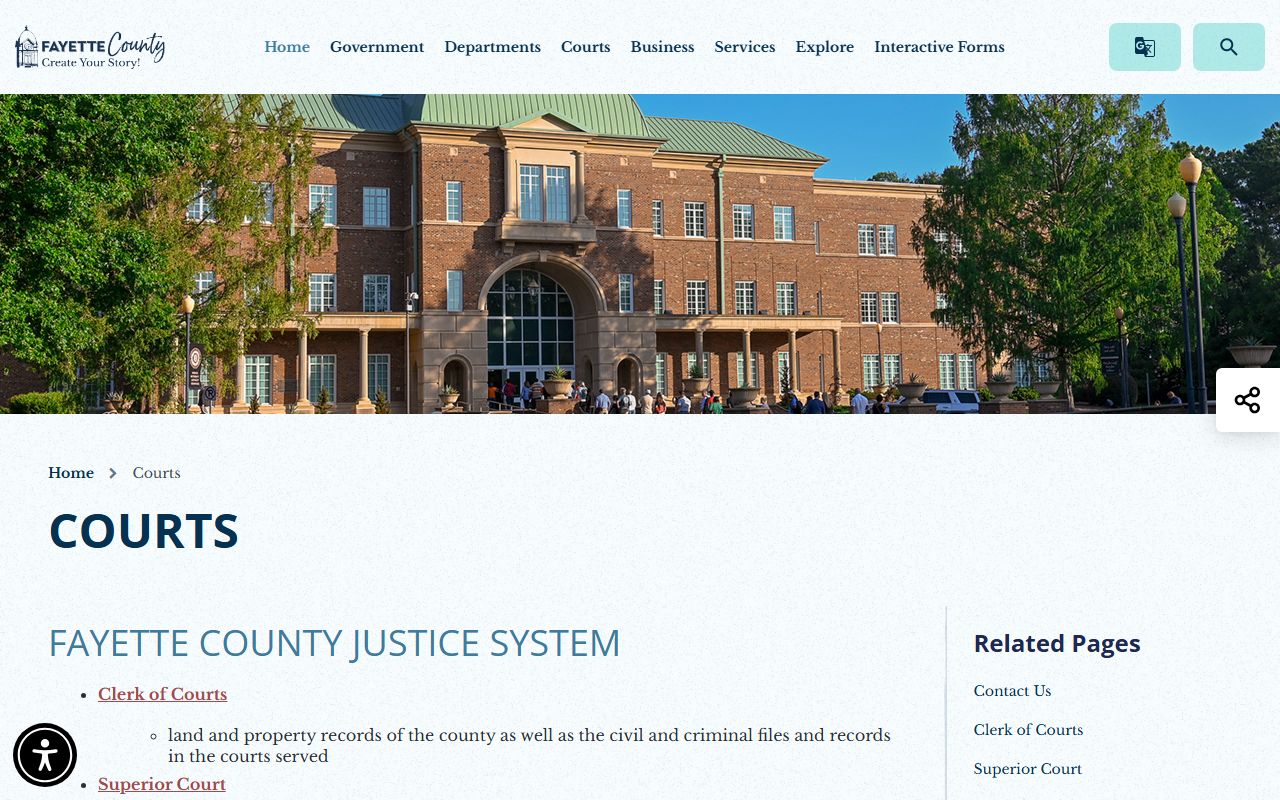
That routing matters because a roster charge does not always predict the court where the final case lands. Felony allegations move toward Superior Court and the Griffin Judicial Circuit District Attorney, while State Court misdemeanor matters move through the Solicitor General.
Find Fayette County Court Records
The Clerk of Superior, State and Magistrate Courts is the main access point for Fayette County criminal case records after a jail arrest. The clerk's online services page links to a Court Docket that covers Superior, State, and Magistrate Courts. The same clerk site also links criminal forms, PeachCourt e-filing, traffic payment, property records, court calendars, and related services. The clerk office is at One Center Drive, Fayetteville, GA 30214, phone 770-716-4290, and is listed as open Monday through Friday, 9:00 a.m. to 5:00 p.m.
- Start with the jail roster if the person is still in custody. Save the exact name, booking number, booking date, statute, offense text, Court/Warrant identifier, and bond amount or "n/a" entry.
- Open the clerk's online services and choose the Court Docket link for Superior, State, and Magistrate Court case searching.
- Search by defendant name first if no case number is known. If the roster shows a Court/Warrant identifier, try that value or provide it to clerk staff.
- Open the case entry and read each charge separately. A single arrest may have multiple charges with different statutes, courts, bond entries, and outcomes.
- Check the clerk court calendars if the docket points to a hearing date, judge, or court session.
- If the online docket does not show the case, contact the clerk during business hours. Very new arrests may not have filed charges yet, and restricted or juvenile matters may require a different access process.
The Fayette Clerk online services page is the local starting point for the Court Docket link.

The docket link is stronger for filed court charges than for brand-new booking details. If the arrest just happened, the jail may show custody information before the clerk's docket shows a filed case.
| Search Field | Use | Limit |
|---|---|---|
| Court Docket | External service linked by the clerk for Superior, State, and Magistrate Court records. | The static capture did not expose every live field. |
| Defendant or party name | Use when only the arrested person's name is known. | Name spelling, suffixes, and middle names may affect results. |
| Case number | Use if a citation, warrant, court notice, attorney, or clerk has provided one. | A jail booking number is not always the same as a court case number. |
| Court or category | Narrows the search among Superior, State, or Magistrate matters when available. | Charge level can change after prosecutor review, so verify instead of guessing. |
Fayette County Charging Documents
The booking charge is the arrest-stage description. The court charge begins with a charging document or court filing. In Fayette County, the prosecutor may decide to file different charges from the booking text, add counts, reduce a count, decline a count, or pursue an indictment in a felony case. The result is a court record that should be checked separately from the jail roster.
| Document | Common Fayette County Use | Why It Matters |
|---|---|---|
| Complaint | Often tied to initial allegations, warrants, or lower-court criminal matters. | It may explain the factual basis or original charge that led to arrest. |
| Information or accusation | Common prosecutor-filed charging route, especially for misdemeanor and some non-indictment matters. | It shows what the prosecutor chose to file in court. |
| Indictment | Grand-jury charging document for felony cases in Superior Court. | It can replace or refine the arrest-stage charge list after review. |
Felony prosecution goes through the Griffin Judicial Circuit District Attorney's Fayette office. The research source identifies Acting District Attorney David J. Studdard, One Center Drive, Fayetteville, GA 30214, phone 770-716-4250. Misdemeanor and traffic prosecution in State Court goes through the Fayette County Solicitor General, Jamie K. Inagawa, at 1 Center Drive, phone 770-716-4260. Prosecutor offices explain filing posture and victim-services routing, but certified copies and docket records are clerk functions.
Defense routing is separate from both the jail and the prosecutor. The Georgia Public Defender Council lists the Fayette County-Griffin Circuit public defender office at 175 Johnson Ave, Suite 001, Fayetteville, GA 30214, phone 770-716-4340. People who cannot afford counsel should use that office or the court-directed application process rather than asking jail staff to interpret charges or give legal advice.
Charge Status and What It Means
Charge status can change after the arrest. A Fayette County roster entry may show why the person was booked, but the docket may later show a pending accusation, indictment, amended count, dismissal, plea, sentence, or nolle prosequi entry. Each count should be read independently, especially when a booking event includes several statutes or a mix of felony, misdemeanor, traffic, warrant, and probation-related allegations.
| Status | What It Means |
|---|---|
| Pending | The charge remains open and has not reached a final disposition on the docket. |
| Amended or reduced | The prosecutor or court record changed the original count, level, wording, or statute. |
| Dismissed | The court record shows the count did not proceed to conviction in that case posture. |
| Nolle prosequi | The prosecutor formally declined to continue that count, often shown as "nol pros" or similar wording. |
| Plea or conviction | The record reflects a guilty plea, verdict, or other conviction event for that specific count. |
| Bound over or indicted | A lower-court or warrant-stage matter moved toward Superior Court felony handling. |
Bond and Release After an Arrest
Bond is a custody issue, but it often appears beside court records after a jail arrest because the first appearance and case filing can affect release. Fayette County publishes detailed bond rules. The jail says a judge may set bond at first appearance, the hearing is not open to the public, and inmates may be bonded out 24 hours a day if eligible. A bond does not end the case. It is a promise and security arrangement connected to future court appearances.
| Bond Type | How It Works in Fayette County |
|---|---|
| Cash bond | Paid by cash or bank-issued certified check for the full amount. Cash must be exact change. |
| Property bond | Requires Fayette County property, original warranty deed, current tax statement, proof of equity, and all deed holders present. |
| Professional bonding company | Uses one of the bonding companies authorized by the Fayette County Jail's published list. |
| Transfer bond | For property outside Fayette County, the other sheriff prepares the bond in a sealed envelope that must not be opened. |
| No-bond or hold | A judge, warrant, probation/parole issue, federal hold, or other agency detainer may prevent release. |
Fayette County Jail cites a $20 cash-only, non-refundable fee for every bond written under O.C.G.A. 15-16-21. A roster value of "n/a" should not be treated as a zero-dollar release. Call the jail at 770-716-4720 or 770-716-4734 when a bond field is unclear or when another hold may block release.
Warrants That Lead to an Arrest
Magistrate Court handles criminal warrant functions in Fayette County, and the clerk forms page includes a Magistrate warrant application. The clerk fee schedule lists the application for arrest warrant fee as $20. The county directory also lists the Sheriff's Warrant Division at 770-716-4770. No official public active-warrant search page was located in the research capture, so warrant questions should be routed carefully through the issuing court, clerk, attorney, or sheriff Warrant Division rather than a private database.
A warrant can become a jail booking when law enforcement serves the warrant and transports the person to Fayette County Jail. The roster may then show a Court/Warrant identifier, a charge row, and a bond field. The court case continues in Magistrate, State, Superior, or another issuing court depending on the charge and warrant type. For bench warrants, the issuing court often controls recall, compliance, hearing dates, and payment questions. For felony warrants, the District Attorney and Superior Court path may control prosecution after arrest.
Charges vs. Convictions
An arrest charge is an allegation. A filed court charge is also not a conviction. A conviction requires a guilty plea, verdict, or other final conviction event entered in court. This distinction is important for Fayette County court records after an arrest because booking pages and docket pages can show serious allegations before any final outcome exists.
| Charge | Conviction | |
|---|---|---|
| Stage | Arrest, filing, accusation, or indictment stage. | Final plea, verdict, or adjudicated outcome for a count. |
| What it proves | Only that an allegation exists or existed. | That the court entered a conviction for that count. |
| Where to verify | Roster, clerk docket, charging document, prosecutor filings. | Final disposition, sentencing entry, certified clerk copy. |
| Practical caution | Charges can be amended, reduced, dismissed, or nolle prossed. | Convictions still need identity and disposition verification before relying on them. |
Sealed or Restricted vs. Expunged Arrest Records
Georgia commonly uses record restriction language for certain criminal history records. Fayette Sheriff's resources describe a Request to Restrict Arrest Record form tied to O.C.G.A. 35-3-37, with a $25 non-refundable fee per arrest cycle or offense date and prosecutor approval as part of the statutory process. Restriction is not the same as automatic erasure of every court, jail, news, or third-party reference.
| Sealed or Restricted | Expunged | |
|---|---|---|
| Georgia wording | Restriction is the key local term for eligible criminal history access limits. | Often used casually, but Georgia records should be checked under restriction rules. |
| Visibility | May limit non-criminal-justice access when the statutory process is approved. | Should not be assumed unless a specific Georgia order or statute applies. |
| Who is involved | Sheriff Records Section, prosecuting attorney, and state criminal-history channels may matter. | Court order and agency implementation questions require official confirmation. |
| Effect on court records | Some records may remain accessible to courts or criminal-justice agencies. | Do not assume all docket traces disappear without checking the clerk. |
Copies, Certified Records, and Clerk Fees
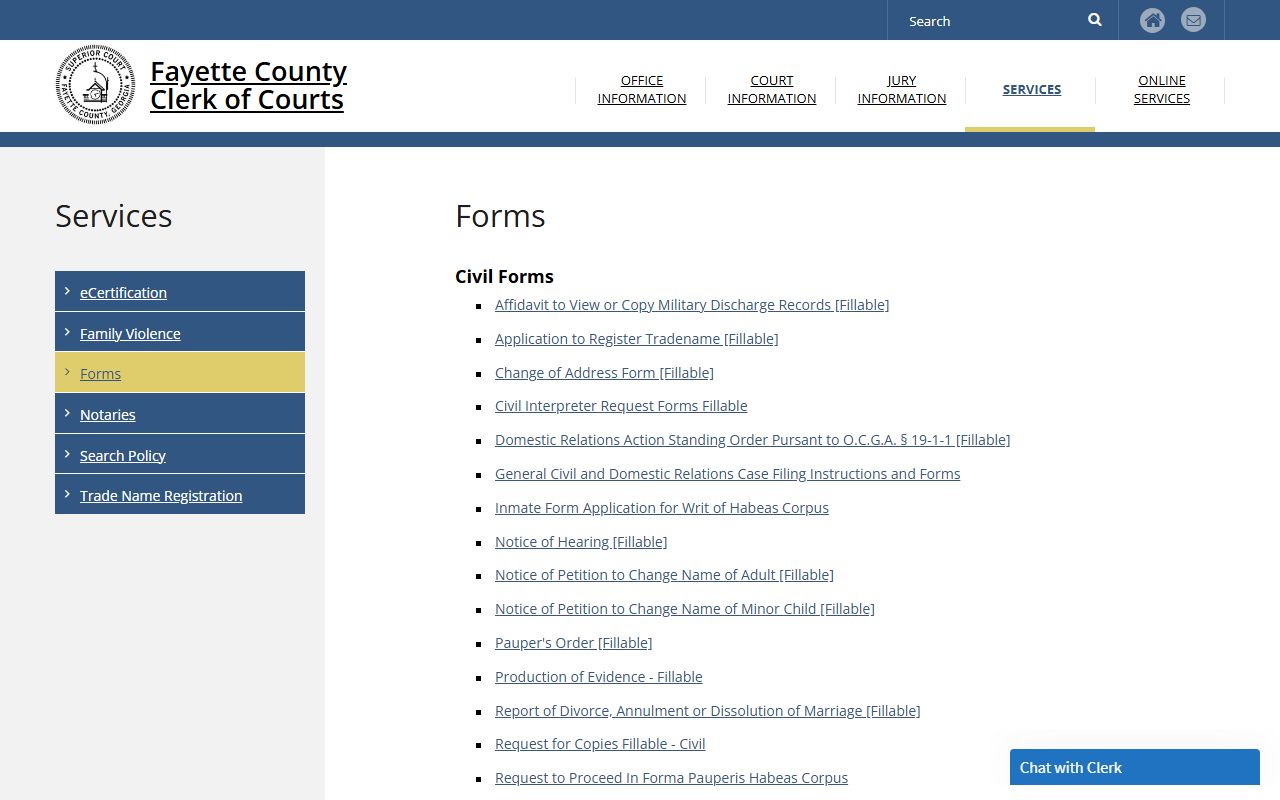
For physical or certified court records after a Fayette County arrest, use the clerk's criminal copy request process rather than the sheriff roster. The clerk forms page lists "Request for Copies Fillable - Criminal" under Criminal Forms. The clerk fee schedule revised July 1, 2024 lists uncertified unassisted copies at $0.50 per page, uncertified assisted copies at $1.00 per page, certified copies at $0.50 per page plus $2.50 for each certification or exemplification with seal, and copy, faxed, or electronic first page at $2.50 plus $0.50 for each page after the first.
The Fayette Clerk forms page is the local source for criminal copy requests and warrant forms.
Certified court copies are the better route when a record must be shown to an attorney, agency, school, licensing body, or another court. A screenshot of a roster or docket entry is not the same as a certified clerk record.
Background Check Considerations
Georgia criminal-history access is separate from a casual court-record lookup. O.C.G.A. 35-3-34 governs criminal-history record dissemination, including consent-based checks and limits on certain conviction information. A person checking Fayette County court records after an arrest should distinguish public docket research from a regulated employment, tenant, insurance, credit, licensing, or volunteer background-screening process.
Important: Fayette County Inmate Population is not a consumer reporting agency, and its content may not be used for FCRA-covered screening decisions.
Restricted Fayette Arrest Court Records
Not every arrest-related record is public in the same way. Juvenile Court handles cases involving people under 17, and adult docket expectations should not be applied to juvenile matters. Georgia's Open Records Act is broad, but records can be withheld or redacted when another law protects them. Medical, mental-health, security, classification, housing, investigative, and juvenile information may have access limits. Court records, jail records, prosecutor records, and state criminal-history records also have different custodians.
When a Fayette County case appears missing, the reason may be timing, misspelling, use of a different court, juvenile status, restriction, a sealed filing, no formal charge yet, or a prosecutor decision not reflected in the jail roster. The safest verification chain is the clerk docket, clerk staff, the appropriate prosecutor office, defense counsel, and the originating law-enforcement records custodian.
Public Record Search
Sponsored Results